Last month the phone was ringing. This month it’s quiet, and when you search for your own service in Montreal, a competitor sits where your listing used to be. Sound familiar?
If it does, you don’t need another list of Google Business Profile tips. You need to know what broke.
Local-business owners on Reddit describe the same frustrations again and again: a well-reviewed, long-established business that only appears when the map is zoomed in on its own street, or rankings that fall even after adding reviews and filling out every service. These aren’t mysteries. They’re symptoms, and each one points to a short list of causes.
This guide works backwards from what you’re seeing to why it’s happening, then gives you a 15-minute check you can run today. For the bigger picture on how Maps fits into search in 2026, see our guide to AI search visibility.
Key Takeaways - In 2026, Whitespark’s survey of 47 local search experts ranked your primary GBP category and your distance from the searcher as the two strongest Maps factors. - Match your symptom first. Brand-only visibility points to relevance. Vanishing a few kilometres away points to distance. - Review count alone rarely explains a gap. - Montreal adds French-language searches and separate municipalities to the mix.
How Does Google Decide Which Montreal Businesses Show on Maps?
In 2026, Google’s own help documentation still says local results depend mainly on relevance, distance and prominence (Google Business Profile Help, “How to improve your local ranking on Google”). Every visibility problem in this article maps back to one of those three, or to a profile that’s been restricted.
Here’s what each means in plain terms:
- Relevance is how well your profile matches the search. Google’s guidance is to provide complete, detailed business information so it can match you to the right queries.
- Distance is how far you are from the searcher, or from the location in their query. If someone doesn’t type “Rosemont” or “Montréal,” Google uses what it knows about where they are.
- Prominence is how well known you are, drawn from links, articles, directories, and your Google review count and rating.
Google doesn’t publish weights. The closest thing the industry has is Whitespark’s Local Search Ranking Factors 2026 report, published in November 2025, where 47 local SEO specialists scored 187 factors (Whitespark). It’s expert opinion, not Google data, but it’s built on years of testing.
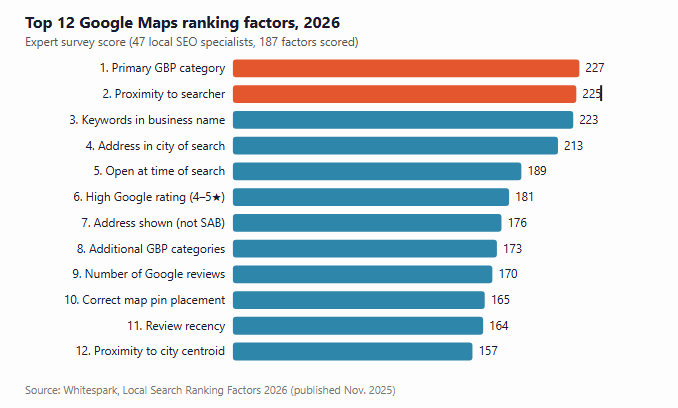
Notice what sits at the top. Category and proximity outscore every review, link and content factor. That’s why a business with 200 reviews can still lose to a closer competitor with the right category.
Which Symptom Matches Yours?
Most ranking drops leave a recognizable pattern. Find the row that sounds like your situation, then jump to those reasons.
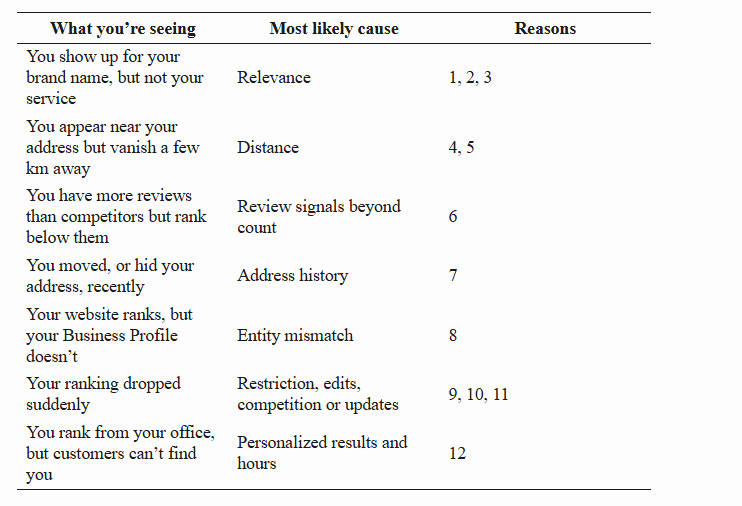
Why Do I Show Up for My Business Name but Not My Service?
In the 2026 Whitespark survey, primary GBP category scored 227, the highest of all 187 factors for Maps rankings (Whitespark, 2026). If people can find you by name but not by “plombier Montréal” or “dentist near me,” Google knows you exist. It just doesn’t see you as a match for the service.
1. Your Primary Category Doesn’t Match What People Search
Your primary category is the single strongest statement you make to Google about what you are. A renovation company listed as “Contractor” competes weakly for “bathroom renovation.” A clinic listed under a broad category may never surface for the specific treatment people search.
Check what your top three competitors use as their primary category. Then check your own. If they differ, that’s your first lead. Additional categories matter too, ranking eighth in the same survey, but they support the primary. They don’t replace it.
A caution: don’t swap categories repeatedly while testing. Each change gives Google a new signal to process. If your drop started right after a category edit, that edit is the first thing to check.
2. Your Services Live on One Generic Page (or Nowhere)
In the 2026 survey, a dedicated page for each service ranked as the number-one factor for local organic results and 24th for Maps. Presence of Google’s predefined services on your profile ranked 22nd, a new factor that went straight into the top tier.
So if your website has a single “Services” page listing eight things, Google has little to connect each service to your profile. The fix is structural: one page per core service, linked from your GBP landing page, and matching services added in the profile’s Services section. Start with the predefined options Google suggests for your category before writing custom ones.
3. Your Profile and Site Speak English to a French-First Market
According to Statistics Canada’s 2021 Census, 70% of workers in the Montreal metropolitan area mainly used French at work, 21% mainly English and 8% both equally (Statistics Canada, “Languages at work: Spotlight on Montréal”). The same release found 80% of those workers were at least bilingual.
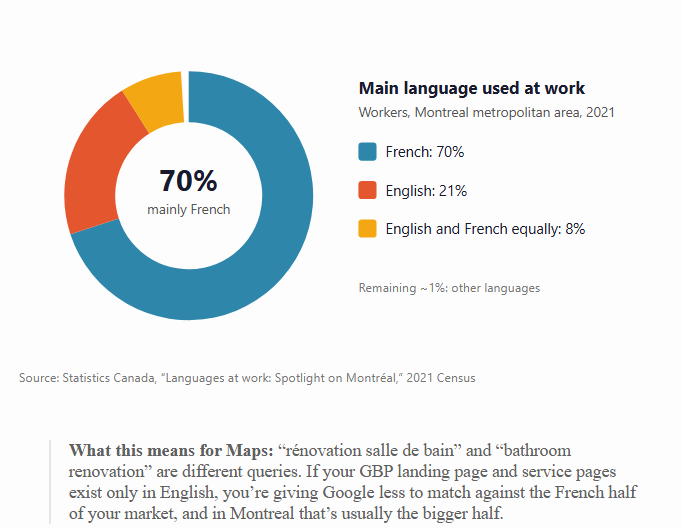
There’s a compliance angle too. Law firm Lavery notes that Quebec’s language office and the courts have treated websites and social media as commercial publications under the Charter of the French language (Lavery). This isn’t legal advice, so confirm your obligations with a professional. But a complete French version helps both your compliance position and your relevance.
Why Do I Disappear From Google Maps a Few Kilometres From My Address?
Proximity to the searcher scored 225 in Whitespark’s 2026 survey, second only to primary category (Whitespark, 2026). If you rank on your own block but disappear in the next borough, that’s often distance doing exactly what it was designed to do.
4. Proximity Is Working as Designed, and Montreal Is Dense
Google calculates distance from the searcher when a query has no location in it. In dense areas like Ville-Marie or the Plateau, dozens of competitors can sit within a short walk of each other. Your ranking radius shrinks as competition around you grows.
This explains the “I only show up when the map is zoomed in” complaint. You’re not invisible. Your visibility is a small circle, and outside it, closer businesses win.
The Montreal municipality trap: “Physical address in city of search” ranked fourth in the 2026 survey. Laval, Longueuil and Brossard are separate cities, and so are on-island municipalities like Westmount, Mont-Royal and Dorval. A business in one of them can struggle for searches that include “Montréal,” even when it’s minutes from downtown.
You can’t move your address to fix proximity. You can strengthen relevance and prominence so your radius stretches further. Which raises the question: how far does your radius actually reach today? The visibility check below shows you how to measure it.
5. Your Map Pin Is in the Wrong Spot
Proper map pin placement ranked tenth in the 2026 Whitespark survey. A pin sitting on the wrong side of a building, at a street corner, or on the wrong block distorts every distance calculation Google makes about you.
Montreal’s older buildings make this more common than you’d think. Multiple entrances, suite numbers, and addresses on one street with the door on another can all push the pin off. Open your profile on Google Maps and zoom all the way in. Is the pin on your actual entrance? If not, correct it in your profile’s location settings.
Why Do Competitors With Fewer Reviews Outrank Me?
In 2026, Whitespark’s experts ranked high Google ratings sixth, review quantity ninth, review recency 11th and a steady flow of reviews over time 14th (Whitespark, 2026). Count is one review signal among four, and all four sit below category and proximity.
6. You’re Counting Reviews. Google Weighs More Than Count.
Picture two plumbers. You have 180 reviews, but the last one came in March. A competitor has 60, with three new ones every week, and sits 1.5 km closer to the searcher. The competitor can win, and it isn’t unfair. It’s the model working as expected.
Customers think similarly. BrightLocal’s Local Consumer Review Survey 2026 found 74% of consumers only care about reviews written in the past three months, and 47% won’t use a business with fewer than 20 reviews (BrightLocal, 2026). That survey polled US consumers, but the logic travels.
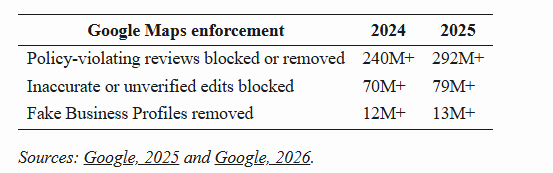
There’s also a quieter problem: reviews that disappear. Google says it blocked or removed over 292 million policy-violating reviews on Maps in 2025 (Google, “New ways we’re protecting businesses on Maps”). If your count dropped overnight, check whether reviews were filtered before assuming a ranking penalty.
Did Moving or Hiding My Address Hurt My Rankings?
“Address is showing on GBP (not a service-area business)” ranked seventh in the 2026 Whitespark survey (Whitespark, 2026). If your visibility collapsed right after a move or after hiding your address, address history is the first place to look.
7. Your Address History Is Working Against You
Report author Darren Shaw has a useful theory. When a profile removes its address, Google still needs a location for it. It may fall back to the address the profile was originally verified at, so rankings don’t vanish. They move back to your old neighbourhood.
That matters if you moved from Mile End to Saint-Laurent and later switched to service-area mode. Google’s guidelines say businesses without a storefront that receives customers must hide their address (Google Business Profile Help). So follow the rules, but do it knowing the risk.
After any move, update the address everywhere: GBP, website footer, schema, and every directory listing. Expect re-verification. And check that your pin landed at the new address, not the old one.
Why Does My Website Rank but My Business Profile Doesn’t?
In 2026, Whitespark’s experts ranked “HTML NAP matching GBP NAP” 15th and keywords in the GBP landing page’s title tag 17th for Maps rankings (Whitespark, 2026). When your site ranks organically but your profile doesn’t, Google may not be confident the two describe the same business.
8. Your GBP and Website Don’t Describe the Same Entity
Start with the landing page linked from your profile. Does it show the exact business name, address and phone number on your GBP? Does its title tag mention your main service and Montreal? Or does your profile point to a generic homepage that barely says what you do?
Then check the wider web. Consistency of listings on Google Maps, Bing Maps and Apple Maps ranked 28th in the same survey, and Apple Maps is gaining weight with consumers: BrightLocal found the share of consumers using it for reviews nearly doubled, from 14% in 2025 to 27% in 2026. Canadian businesses should also check Yellow Pages / PagesJaunes, 411.ca, Yelp, Bing Places and Apple Business Connect.
The bilingual name split: Montreal businesses often appear as “Plomberie Tremblay” in one directory and “Tremblay Plumbing” in another, with a tracking number here and a main line there. To you, that’s one business. To a data aggregator, it can look like two. Pick one official name, as registered, and use it everywhere.
Why Did My Google Maps Ranking Drop Suddenly?
Google says it removed over 13 million fake Business Profiles and blocked 79 million inaccurate or unverified edits on Maps in 2025 (Google, 2026). At that scale, a sudden drop can come from enforcement, an edit you didn’t make, or a change in who you’re competing against.
9. Your Profile Was Suspended or Your Reviews Were Restricted
Suspensions are the most dramatic drop, because your listing stops appearing altogether. Google’s guidelines state that adding unnecessary information to your business name isn’t permitted and could result in suspension (Google Business Profile Help). “Tremblay Plumbing – Emergency Plumber Montreal 24/7” is exactly the kind of name that gets flagged.
Review restrictions are quieter. Google says violations of its fake engagement policy can mean no new reviews for a set period, existing reviews unpublished, or a warning shown to customers (Google Business Profile Help). In July 2026, Search Engine Roundtable reported a repeat violation that brought a two-month restriction, where one month had been typical (Search Engine Roundtable).
If you’re suspended, fix the violation first, then use Google’s appeals tool. Google lists official business registration, licences, tax certificates and utility bills as helpful evidence, and says names and addresses on documents should match the profile (Google Business Profile Help). For Quebec businesses, your Registraire des entreprises record is the obvious starting document. Once you open the evidence form, you have 60 minutes to submit it.
10. Your Profile Was Edited Without You Noticing
Anyone can suggest edits to a Business Profile, and Google sometimes applies them. A changed category, a new website URL, altered hours or a moved pin can each cost rankings without a single notification you noticed.
Google is improving this. In April 2026, it announced proactive email alerts so verified owners can review important edits before they go live (Google, 2026). Still, check your profile manually after any unexplained drop. Compare your category, hours, address, phone, website and pin against what you last set. Don’t forget the email inbox tied to your profile, either. Is anyone actually reading it?
11. The Competition Changed, or the Algorithm Did
Sometimes nothing changed on your side. A new competitor opened nearby, a rival started collecting reviews weekly, or a spam listing appeared with a keyword-stuffed name. “Removal of spam listings through spam fighting” ranked 19th in Whitespark’s 2026 Maps factors, which tells you how much fake competitors can move results. Report them using “Suggest an edit” on Maps, or Google’s business redressal complaint form for repeat offenders.
Algorithm updates play a role too. Search Engine Roundtable reported that Google’s May 2026 core update ran from May 21 to June 2, and its August 2026 spam update from August 18 to 21 (Search Engine Roundtable). Line your drop up against those dates. If it matches, avoid making big changes mid-rollout. Wait for things to settle, then compare.
Why Do Customers Say They Can’t Find Me When I Rank Fine From My Office?
“Business is open at time of search” debuted at fifth place in Whitespark’s 2026 survey, making it one of the most influential new factors (Whitespark, 2026). If you check rankings from your desk during business hours, you may be seeing your best-case result, not what customers see.
12. Your Rank Check Is Personalized, and Your Hours May Hide You
Two things skew a self-check. First, Google measures distance from the searcher, so your office is the one spot where proximity helps you most. Second, open hours now affect ranking. Darren Shaw writes that businesses start dropping about an hour before closing and get displaced by open competitors once they’re closed.
So a customer in Verdun searching at 8 p.m. may see a very different list than you do in Saint-Henri at 10 a.m. Don’t fix this by listing fake hours. Shaw warns it’s against Google’s guidelines and frustrates customers who show up. If you genuinely take calls after hours, reflect that honestly. And track rankings across a grid of points, not from one desk.
Google Maps Visibility Check: A 15-Minute Diagnostic
Google’s ranking inputs of relevance, distance and prominence can each be tested without paid tools (Google Business Profile Help). Run these checks in order and note what you find. By the end, you’ll know which of the 12 reasons above apply to you.
- Search from three Montreal neighbourhoods. Use a free location-simulation tool, or ask people in, say, the Plateau, Verdun and Saint-Laurent to search your main service. Where you drop out tells you how wide your proximity radius is (reasons 4, 12).
- Search your category, not your brand. Try “plombier” or “physiotherapist near me,” not your business name. Brand-only visibility points to relevance (reasons 1–3).
- Search in both French and English. Compare “rénovation cuisine Montréal” with “kitchen renovation Montreal.” A gap between them usually means your French content is thin (reason 3).
- Check your primary category. Compare it against the top three businesses in the Map Pack for your main service (reason 1).
- Compare reviews and review recency. Look at rating, total count and the date of the last five reviews for you and each top competitor (reason 6).
- Check the landing page connected to your GBP. Confirm it matches your profile’s name, address and phone, and clearly names your main service and Montreal (reason 8).
- Check NAP consistency. Search your phone number and business name in quotes. Look for old addresses, alternate names and duplicate listings (reasons 7, 8).
- Check whether each service has its own page. Every core service on your GBP should have a matching page on your website (reason 2).
If most boxes check out and you’re still not showing, look at reasons 9 to 11: restrictions, unnoticed edits, and competitor or algorithm changes.
Not Sure Why Your Montreal Rankings Dropped?
Some drops have one clear cause. Most have two or three overlapping ones, like a category change during a core update while a new competitor opens nearby. Untangling that takes grid tracking, profile history and a side-by-side competitor review.
Request a Local Visibility Audit from PopNest. We’ll map where you rank across Montreal, identify which of these 12 causes apply to you, and give you a prioritized fix list.
Frequently Asked Questions
Why does my business only show on Google Maps when I zoom in?
That’s usually proximity. Whitespark’s 2026 survey ranked distance from the searcher as the second-strongest Maps factor. Zooming in shrinks the search area until closer competitors drop out. To widen your visibility, strengthen relevance and prominence through your category, service pages and steady reviews.
Does adding more reviews fix a Google Maps ranking drop?
Not by itself. In Whitespark’s 2026 survey, rating, recency and a steady review flow ranked alongside quantity, and all four ranked below category and proximity. BrightLocal found 74% of consumers only care about reviews from the last three months, so a consistent flow beats a one-time burst.
Do I need a French website to rank on Google Maps in Montreal?
It’s not a formal ranking requirement, but it matters. Statistics Canada found 70% of Montreal-area workers mainly used French at work in 2021, so many local searches happen in French. French service pages give Google more to match, and the Charter of the French language may also apply to your site.
Can a competitor or stranger change my Google Business Profile?
Anyone can suggest edits, and some get applied. Google blocked 79 million inaccurate or unverified edits on Maps in 2025 and is rolling out email alerts so owners can review important edits before they go live. Check your profile details after any unexplained drop.
Can I put “Montreal” or my main service in my business name?
Only if it’s part of your real, registered business name. Google says adding unnecessary information to your name can lead to suspension. Keywords in names ranked third in Whitespark’s 2026 survey, which is exactly why spammers do it. For a legitimate business, the suspension risk isn’t worth it.
The Bottom Line
A business that stops showing on Google Maps almost always has a diagnosable reason. Start with the symptom, not a random checklist of tips.
- Brand-only visibility usually means a category, services or French-content gap.
- Vanishing a few kilometres away usually means proximity, pin placement or municipality.
- A sudden drop calls for checking restrictions, edits, competitors and update dates, in that order.
Run the 15-minute visibility check above, then work through the reasons it flags. Want to go further?
Sources
- Google Business Profile Help, “How to improve your local ranking on Google,” retrieved 2026-09-24, https://support.google.com/business/answer/7091
- Google Business Profile Help, “Guidelines for representing your business on Google,” retrieved 2026-09-24, https://support.google.com/business/answer/3038177
- Google Business Profile Help, service-area business setup, retrieved 2026-09-24, https://support.google.com/business/answer/10514137
- Google Business Profile Help, “Fix suspended or disabled profiles,” retrieved 2026-09-24, https://support.google.com/business/answer/4569145
- Google Business Profile Help, “Business Profile restrictions for policy violations,” retrieved 2026-09-24, https://support.google.com/business/answer/14114287
- Google, “New ways we’re protecting businesses on Maps” (2025 Trust & Safety figures), April 2026, retrieved 2026-09-24, https://blog.google/products-and-platforms/products/maps/new-ways-were-protecting-businesses-on-maps/
- Google, “Google Maps uses AI to fight fake Business Profiles” (2024 figures), April 2025, retrieved 2026-09-24, https://blog.google/products-and-platforms/products/maps/google-business-profiles-ai-fake-reviews/
- Whitespark, “Local Search Ranking Factors 2026,” Darren Shaw, November 2025, retrieved 2026-09-24, https://whitespark.ca/local-search-ranking-factors/
- BrightLocal, “Local Consumer Review Survey 2026,” February 2026, retrieved 2026-09-24, https://www.brightlocal.com/research/local-consumer-review-survey/
- Statistics Canada, “Languages at work: Spotlight on Montréal,” 2021 Census, retrieved 2026-09-24, https://statcan.gc.ca/o1/en/plus/3032-languages-work-spotlight-montreal
- Lavery, “Publication of the Regulation clarifying the obligations of Bill 96,” retrieved 2026-09-24, https://www.lavery.ca/en/publications/our-publications/5384-publication-of-the-regulation-clarifying-the-obligations-of-bill-96-impacts-on-trademarks-for-products-advertising-and-public-signs-and-posters.html
- Search Engine Roundtable, “Google Business Profile Restrictions & Penalties Are Additive,” July 3, 2026, retrieved 2026-09-24, https://seroundtable.com/google-business-profile-restrictions-double-41594.html
- Search Engine Roundtable, “Google Search Ranking Volatility Continues Post August Spam Update,” 2026, retrieved 2026-09-24, https://www.seroundtable.com/google-search-ranking-volatility-continues-41952.html