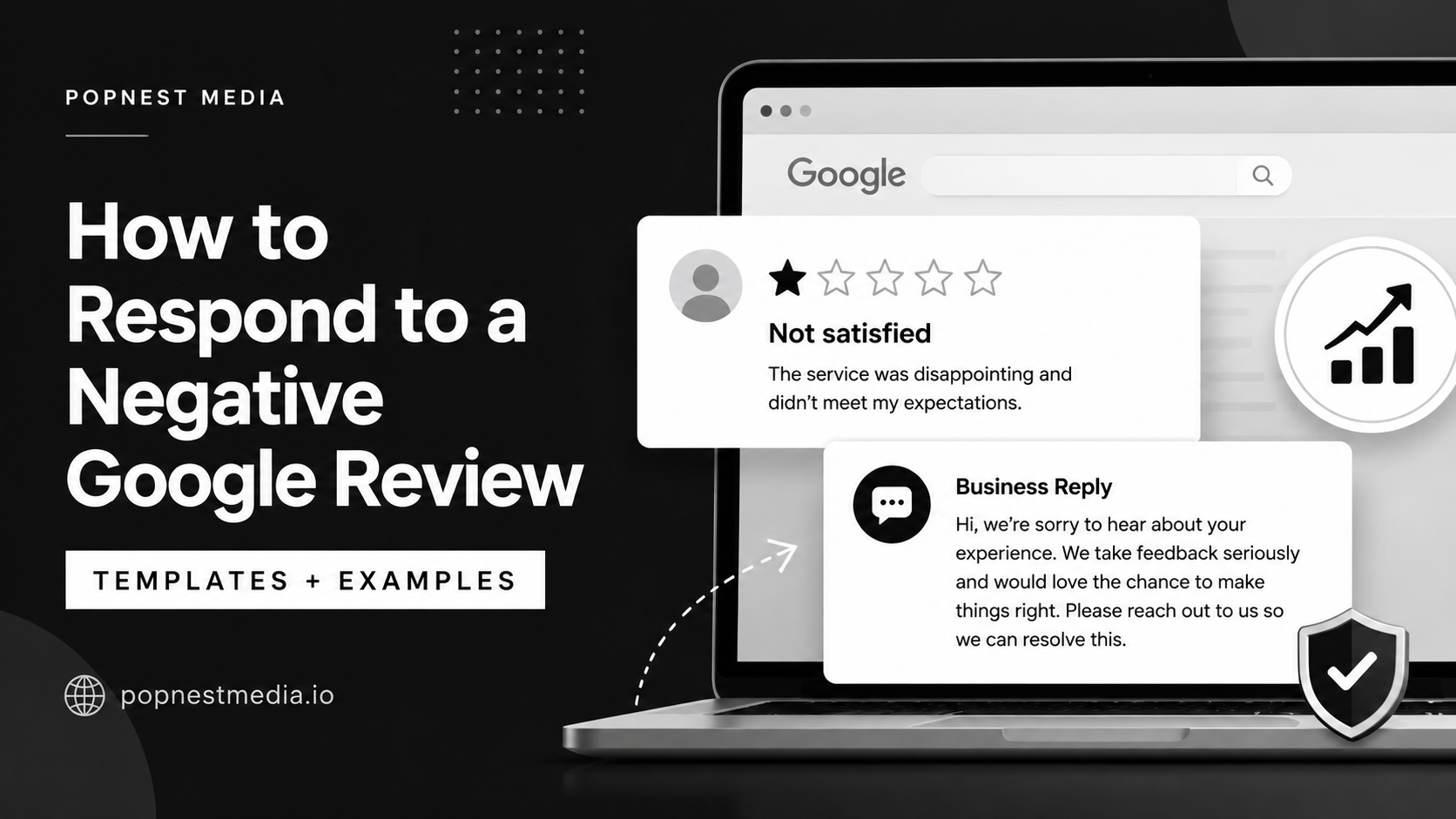

You should not act unprossionaly while replying to a negative busines review, think of a proper way, use a formal template and add the query resolving tone.
A negative Google review does not have to become a permanent stain on your business reputation. In many cases, the way you respond to the complaint can influence potential customers almost as much as the original review itself.
Think about how people choose businesses today. Before visiting a restaurant, hiring an agency, booking a clinic, choosing a contractor, or even walking into a local store, many customers check Google first. They look at the overall rating, but they also read what unhappy customers have said and, importantly, how the business responded when something went wrong.
That means a negative review is not simply a conversation between you and one unhappy customer. It is a public demonstration of how your business handles problems.
The best approach is not to fight negativity with negativity or paste the same apology under every bad review. Instead:
Read the complaint. Reflect on what actually happened. Respond directly. Resolve what you can. Then improve the underlying experience if the criticism exposed a genuine weakness.
That is how negative reviews can become opportunities to build trust rather than simply damage it.
Why Your Response to a Negative Google Review Matters
Imagine that someone searches for your business and finds this review:
“I went to their office for a meeting, but there was no proper air conditioning and the meeting environment was uncomfortable.”
A potential customer reading that review may immediately become hesitant. But now imagine the business has responded:
“We're sorry that the meeting environment wasn't comfortable. Most of our consultations are conducted online, so our current office is primarily designed for our operational team rather than longer client meetings. We should have communicated this before your visit. For future consultations, we'd be happy to arrange an online meeting or organise an in-person meeting in a more comfortable professional space.”
The negative review still exists. But the impression has changed. The reader can see that the business:
- understood the complaint;
- did not attack the reviewer;
- acknowledged its responsibility;
- explained the situation without making excuses;
- and offered a practical solution.
Google itself says that replying to reviews demonstrates that you value customer feedback, and business replies appear publicly beneath reviews. Your response therefore isn't written only for the person who complained.
You are also writing it for your next customer.
Use the Read, Reflect, Respond Method
Before answering a negative review, follow three simple steps:
Read
Read the entire review carefully. Do not react only to the star rating or the most offensive sentence. Identify what the customer is actually complaining about.
Was it:
- poor communication?
- a delayed order?
- employee behaviour?
- pricing?
- an uncomfortable physical environment?
- a misunderstanding?
- an expectation that was never properly explained?
- or something that did not actually happen?
Until you understand the complaint, you cannot write a useful response.
Reflect
Before clicking Reply, check what actually happened. Speak with the employee involved if necessary. Look at the order. Check the booking. Review the messages. Ask yourself one important question:
Is there something we could genuinely have handled better?
This is especially important when a review feels unfair.
The customer's entire interpretation may not be correct, but there may still have been a communication failure or service gap on your side.
Respond
Once you understand what happened, reply clearly and professionally. Your response should be timely, but it should not be impulsive. A useful internal target for many businesses is to deal with negative reviews within roughly 24 to 48 hours, while still allowing enough time to investigate before replying.
A response written five minutes after reading an angry review can easily become emotional. A response written after understanding the situation is much more likely to protect your reputation.
Answer Directly and Don't Hide Behind a Generic Reply
One of the biggest mistakes businesses make is posting generic responses.
For example:
“Thank you for your valuable feedback. We strive to provide the best possible service to all our customers.”
It sounds polite. But imagine the customer complained:
“I waited 45 minutes even though I had a confirmed appointment.”
Your response hasn't mentioned the delay at all. It feels automated.
A better reply would be:
“Hi Sarah, we're sorry that you had to wait despite having a confirmed appointment. We understand how frustrating that can be when you've planned your day around a scheduled time. We've reviewed the scheduling issue with our team and are working on improving the time allocated between appointments.”
Now the customer knows you actually read the review. A template should help you structure a response. It should never make your response sound copied and pasted.
Acknowledge the Review; Even When It Feels Unfair
Not every negative review will be completely fair. Some customers misunderstand policies. Some leave out important details. Some remember events differently. And occasionally, a customer may blame the business for something outside its control.
That still does not mean your first sentence should be:
“This review is completely false.”
Acknowledging someone's experience is different from admitting that every statement they made is true. You can say:
“We're sorry that the experience left you disappointed.”
Or:
“We understand why this situation was frustrating.”
Or:
“Thank you for raising this. We have reviewed what happened and would like to clarify a few details.”
These phrases allow you to stay professional without agreeing with inaccurate information.
Don't Justify Everything; Take Accountability
There is a major difference between an explanation and an excuse. Customers rarely want to read a paragraph explaining why the business could not possibly have done anything differently. Suppose the complaint is:
“I came to their office and there wasn't adequate air conditioning.”
A defensive response might be:
“We are an online service business. Customers aren't supposed to come to our office.” Even if the statement is technically correct, it sounds like you are blaming the customer.
Instead:
“We're sorry the meeting environment wasn't comfortable. Since most of our client consultations are online, our existing office is primarily arranged for our internal team. However, we should have communicated the meeting setup before your visit.”
You can explain the situation and take accountability. That balance is important.
Offer a Resolution, Not Just an Apology
An apology acknowledges the problem. A resolution answers: What happens now? Depending on the situation, a resolution could mean:
- correcting an order;
- replacing an incorrect product;
- scheduling another appointment;
- asking a manager to contact the customer;
- refunding or compensating where genuinely appropriate;
- offering a better future service;
- correcting inaccurate information;
- improving a process;
- changing where or how meetings happen.
The resolution needs to match the complaint.
Do not automatically offer a discount for every negative review. In fact, Google prohibits businesses from offering incentives such as payment, discounts, or free goods/services in exchange for someone posting, changing or removing a review.
There is an important difference between legitimately resolving a customer's service problem and saying:
“We'll give you 20% off if you remove the one-star review.”
The first is customer service. The second can become review manipulation.
A Real Example: Turning an Office Complaint Into an Improvement
Let's return to the air-conditioning example because it demonstrates something much bigger than writing a good reply. A customer visits the office of a service-based company. They leave a negative review because the meeting environment was uncomfortable and did not have suitable air conditioning. You could respond in two ways.
Solution 1: Change How Future Meetings Are Arranged
If your company mainly works online, say so respectfully and offer a better option:
“We're sorry your visit wasn't as comfortable as expected. Most of our client meetings are conducted online, and we should have made that clearer before your visit. For future consultations, we'd be happy to arrange a convenient online meeting so you can speak with our team without having to travel.”
That is already better than arguing. But there is another possibility.
Solution 2: Actually Improve the Physical Meeting Experience
Suppose physical client meetings are important to your business. The review may have revealed a real operational problem. You could arrange future meetings in a professional co-working space with proper air conditioning, comfortable seating, a suitable meeting room, reliable internet and a better overall client environment. Now something interesting has happened:
The negative review has helped you identify a customer-experience problem you may not have noticed yourself.
The complaint has created an improvement. And that improvement can become part of your public reputation.
Don't Stop at the Review Reply; Show That You Improved
This is an important reputation-management opportunity that many businesses miss. Imagine that you resolve the office issue and, several days later, publish a social post:
You Spoke. We Listened.
“Recently, we received feedback about making our in-person client meetings more comfortable. We took it seriously. From now on, clients who prefer physical consultations can also meet our team in a dedicated professional co-working meeting space with air conditioning and a comfortable meeting environment. Thank you to everyone who helps us improve.”
You have now transformed the situation:
Negative feedback → acknowledgement → resolution → operational improvement → public proof
You are not naming or attacking the reviewer. You are showing your wider audience that feedback results in action. That can actually increase trust. Customers do not expect businesses to be perfect. They do expect responsible businesses to improve.
Negative Google Review Response Templates
Different complaints require different responses. The following templates are starting points. Always customise them according to what actually happened.
Template 1: Valid Complaint
Use this when the customer has identified a genuine mistake or service problem.
Hi [Name], thank you for bringing this to our attention. We're sorry about [specific issue]. You were right to expect a better experience from us. We've reviewed what happened and are taking steps to [specific action/improvement]. Please contact us at [contact method] so we can also discuss how we can resolve the matter for you.
Why it works
It acknowledges the specific complaint instead of hiding behind corporate language.
More importantly, it explains what is being done.
Template 2: Unfair or Partially Inaccurate Complaint
Use this when your records do not completely match the review.
Hi [Name], we're sorry that you were unhappy with your experience. We've reviewed the situation internally and some of the details appear to differ from our records. We'd still like to understand your concerns properly and clarify what happened. Please contact us at [contact details], and we'll be happy to discuss the situation directly.
Do not write: “You're lying.” Do not turn the review section into a courtroom.
Future customers will judge your professionalism before they decide who was right.
Template 3: Misunderstanding or Miscommunication
Sometimes the business delivered exactly what it intended to provide, but the customer expected something different. That may still reveal a communication problem.
Hi [Name], we're sorry for the confusion regarding [specific issue]. It appears there may have been a misunderstanding about [service/policy/price/timing]. We should have communicated this more clearly before your visit/purchase. We've reviewed how this information is presented so we can make it clearer for future customers. Please contact us if you'd like us to discuss your situation further.
Instead of telling the customer: “You misunderstood.” Ask yourself: “Why was it easy to misunderstand?” That question can improve your website, staff scripts, sales process and customer communication.
Template 4: The Issue Has Already Been Resolved
Sometimes the customer contacted you after posting the review and the issue is now fixed.
Your public reply can reflect that. Hi [Name], thank you for speaking with our team. We're glad we were able to resolve the issue regarding [short description]. We've also taken your feedback into consideration internally so that we can improve the experience going forward. Thank you for giving us the opportunity to make things right.
Google says customers are notified when a business responds and can still edit their review afterward. You do not need to aggressively ask: “Can you delete the review now?” Resolve the experience first. Let the customer decide whether their review should change.
Template 5: You're Still Working on the Complaint
Sometimes you cannot resolve something immediately. Do not pretend it has already been fixed.
Hi [Name], thank you for bringing this to our attention. We understand your concern regarding [specific issue]. Our team is currently reviewing the matter and working on the appropriate solution. We don't want to promise something before we can deliver it, but the issue is being actively addressed. We'll be happy to update you once we have more information. This response does three things: It acknowledges the complaint. It tells the customer the business is working on it. And it avoids making a false promise.
Template 6: Better Future Service
Sometimes you cannot undo the original experience, but you can change the next one.
Hi [Name], we're sorry that your experience with [specific issue] didn't meet expectations. Although we cannot change what happened during your visit, we've reviewed the situation and have introduced [specific improvement] for future appointments. We appreciate the feedback because it helped us identify something we needed to improve. This is particularly useful when feedback leads to a real process change.
What to Avoid When Responding to Negative Reviews
A weak response can sometimes create more damage than the review itself.
1. Generic Replies
Avoid repeating the same response under every complaint: “Thank you for your feedback. We value all of our customers.” If someone complained about pricing, discuss pricing. If they complained about waiting time, discuss waiting time. If they complained about communication, discuss communication.
Answer directly.
2. Ignoring Negative Reviews
Not every review requires a long explanation. But repeatedly leaving unhappy customers unanswered can make the business look disconnected from its customers. Google itself encourages helpful responses because they demonstrate that businesses are responsive to customer feedback.
3. Using Harsh Language
Avoid sarcasm, insults and personal attacks. Even if the reviewer is rude. A response like: “Maybe you should have read our website before complaining.” may feel satisfying for 30 seconds.
But thousands of potential customers could eventually see it. Your response should represent the professionalism of the business, not the emotion of the person typing it.
4. Becoming Too Emotional or Sentimental
Do not write a five-paragraph emotional defence of your company. You do not need to explain how hard your team works, how personally hurt you are by the review or why the customer should feel guilty. Keep the discussion centred on:
the customer's experience + what happened + what can be done now.
5. Violating Google's Policies
Do not try to manipulate your rating. Google's policies prohibit fake engagement and incentivised review activity, including offering payments, discounts, free products or services in exchange for a review being posted, revised or removed. Google also states that contributions should represent genuine experiences.
So avoid practices such as:
“Delete your review and we'll give you a refund.”
or
“Change your one-star review to five stars and we'll give you a discount.”
Solve the customer's problem because it is the right thing to do—not because you are purchasing a better rating.
What If the Negative Review Is Fake?
A negative review and a policy-violating review are not automatically the same thing. You may strongly disagree with a reviewer and the review may still be allowed.
Google says Maps contributions should reflect genuine experiences and identifies fake engagement, rating manipulation and other prohibited content in its policies.
If you genuinely believe a review violates Google's policies, report it through the appropriate Google process. But don't report every one-star review just because it makes your company look bad. Sometimes the better question is:
“Is this criticism telling us something useful?”
Use Negative Reviews as Business Research
This is probably the most valuable lesson. Do not only analyse individual reviews. Analyse patterns. One complaint about waiting time may be an isolated situation. Ten complaints about waiting time are telling you something about operations. One complaint about confusing pricing may be a misunderstanding. Twenty complaints about confusing pricing probably mean the pricing is not being communicated clearly enough.
Pay attention when customers repeatedly mention:
- waiting times;
- customer support;
- pricing confusion;
- delivery problems;
- employee behaviour;
- office conditions;
- appointment management;
- poor communication;
- product quality;
- unclear policies.
Those reviews are giving you free customer research. Your response strategy therefore shouldn't only be: “How do we protect our Google rating?” It should also ask: “What is our Google rating teaching us about the business?”
A Simple Negative Review Response Formula
When you don't know what to write, use this five-part framework:
1. Acknowledge
Show that you have read the customer's experience.
2. Address the Specific Problem
Mention the actual complaint rather than giving a generic response.
3. Take Accountability Where Appropriate
Do not justify something the business genuinely could have handled better.
4. Offer a Resolution
Resolve the immediate issue or explain what will improve in the future.
5. Keep It Respectful
Do not argue, become emotional or attack the customer.
For example:
“Hi John, we're sorry about the delay you experienced with your order. We understand how frustrating it is to receive an order later than expected. We've reviewed what happened with our fulfilment team and are improving how delays are communicated. Please contact us at [contact method] with your order details so we can look into your case and help.”
Simple.
Specific.
Professional.
Useful.
The Bigger Strategy: Resolve, Improve and Communicate
Good review management doesn't end after clicking Reply.
Think of it as a cycle:
Read → Reflect → Respond → Resolve → Improve → Communicate
A customer tells you what went wrong. You investigate it. Then, you respond professionally. You resolve what you can. You improve the process that created the problem. And when the improvement is meaningful, you communicate it to your audience.
For example:
“You asked for easier appointments. Online booking is now available.”
“You asked for more flexible consultations. Virtual appointments are now available.”
“We received feedback about our in-person meeting environment. We've now arranged a dedicated professional meeting space for client consultations.”
This is much more powerful than pretending negative feedback never existed. It tells customers: We listen. We learn. We improve.
Final Thoughts
A negative Google review should not automatically trigger panic, anger or an attempt to have the review removed. Start by understanding it.
Read before replying. Reflect before reacting. Answer the actual complaint. Acknowledge the experience even when you disagree with parts of it. Don't hide behind excuses. Take accountability where it is deserved. Offer a genuine resolution. Stay respectful.
And when a customer points out a real weakness, don't just write a better response.
Build a better experience. Then, when appropriate, show people what changed. The most trusted businesses are not necessarily the businesses that never receive criticism. They are often the businesses that show customers:
“When you tell us something is wrong, we listen and we do something about it.”