
How to Get Your Business Recommended by ChatGPT
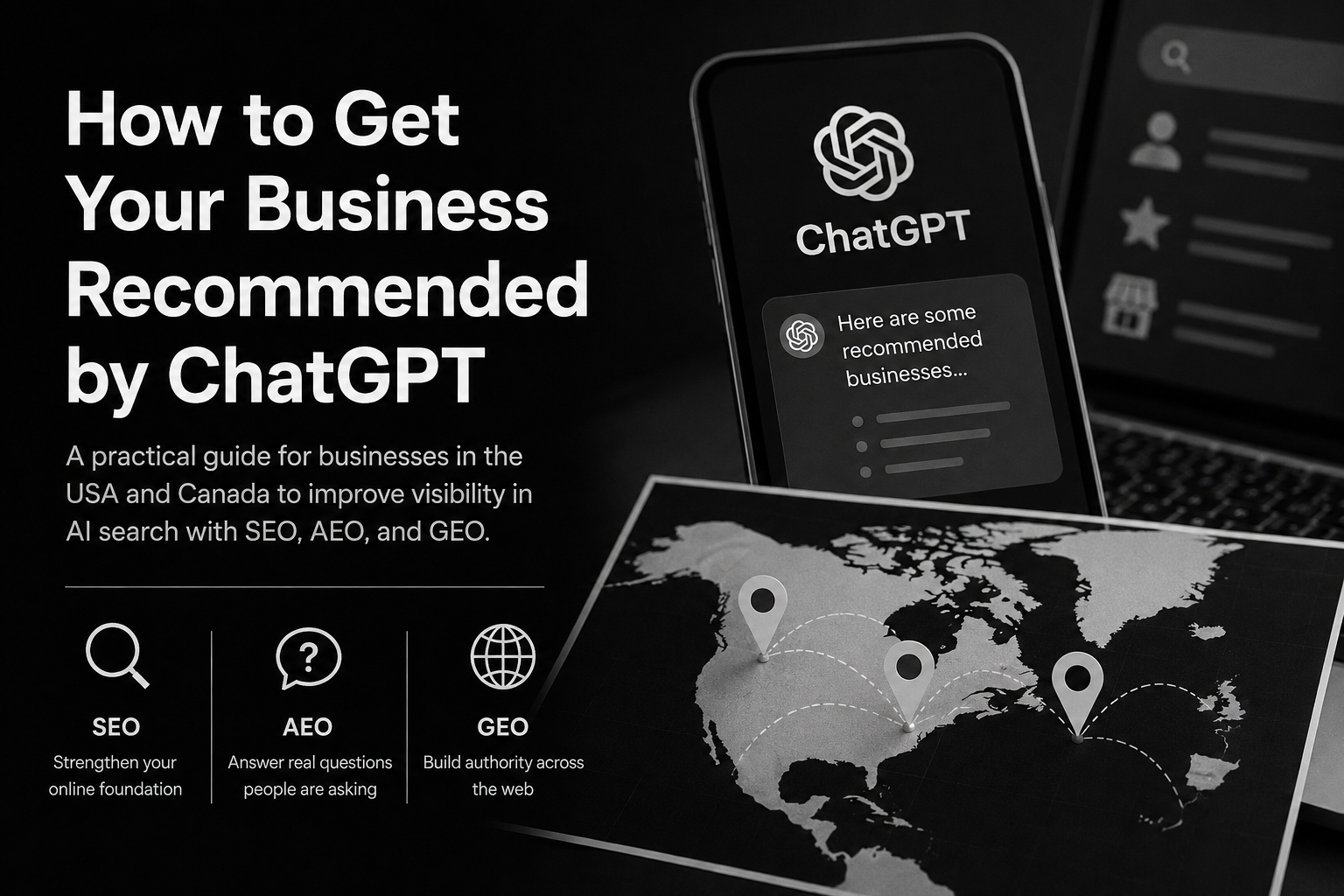
What businesses in the USA and Canada need to know about SEO, AEO, GEO, and the new rules of AI search! A few years ago, a customer looking for an SEO agency in Toronto would probably open Google, scan the first page, compare a few websites, and make a decision. Today, that same customer might ask ChatGPT: “What are the best SEO agencies in Toronto for a small business?” That is a very different search experience.
The customer is no longer asking Google to find ten websites. They are asking an AI tool to help narrow down the decision. For businesses, this creates a new question:
How do you become one of the companies ChatGPT can find, understand, and recommend?
There is no secret setting for this. You cannot pay ChatGPT to put your company at the top of an answer, and no SEO agency can honestly guarantee that it will. What you can do is build a stronger digital footprint. That means making your business information consistent, answering the questions your customers actually ask, building authority around your subject, earning relevant mentions, and making sure your website can be found by AI search. This is where SEO, AEO, and GEO come together.
What Does It Mean to Be Visible in ChatGPT?
ChatGPT visibility is simple to understand. It means your business shows up when someone asks an AI search tool a question that is relevant to what you sell. Consider a small digital marketing agency in Montreal. A potential customer might ask:
“Which digital marketing agencies in Montreal work with small businesses?”
The agency does not need to be mentioned in every answer on the internet.
But if it consistently appears when people ask relevant questions, that can become a valuable source of new business.
This is one of the biggest differences between traditional search and AI search. Google gives you a ranking for a particular keyword. AI search gives you something closer to a recommendation. That changes what businesses need to pay attention to. It is no longer enough to ask, “What keywords do we rank for?” You also need to ask:
“What questions does our business appear in?”
“How is our company described?”
“Which sources are being used to support the answer?”
OpenAI's published guidance explains that ChatGPT Search uses multiple factors when ranking results and does not guarantee a particular position. OpenAI's ChatGPT Search guidance
That means there is no reliable shortcut. The better strategy is to make your business easier to understand and verify.
How Does ChatGPT Find Information About a Business?
Your website is important, but it is only one piece of the puzzle. A business leaves information about itself all over the internet. There is your website. Then there is your Google Business Profile, LinkedIn page, business directories, customer reviews, industry publications, social profiles, local websites, interviews, articles, and other mentions. Together, these create a picture of the business. So just think that your website is suggesting:
ABC Digital Marketing, Toronto Your Google Business Profile says: ABC Digital Marketing Your LinkedIn page says: ABC Digital A directory has an old phone number. Another website says you are based in Montreal. A customer may still figure out that these profiles belong to the same company. A search system has a harder job. This is why one of the simplest GEO lessons is also one of the most important: Make the facts about your business consistent.
1. Get Your Business Information Right
Before worrying about advanced GEO tactics, check the basics. Is your business name consistent? Is your address correct? Is your phone number current? Does your website clearly state where you operate? Do your major profiles describe your services accurately? These details matter more than many businesses realise.
For a company targeting Toronto, for example, Toronto should not appear on the website simply because it is a keyword you want to rank for. The site should clearly explain that the business serves customers in Toronto. The same principle applies to companies targeting New York, Austin, Miami, Dallas, Vancouver, Calgary, Ottawa, or other markets across the USA and Canada. Your descriptions do not need to be copied word for word across every platform.
Your important facts should simply agree. If your business is a Toronto SEO agency, the web should not make it look like you are three different companies in three different cities.
2. Make It Obvious What Your Business Does
There is a strange habit in modern business websites. Companies spend a lot of time trying to sound impressive and very little time explaining what they actually do.
Take this sentence:
“We create digital experiences that help ambitious brands unlock their potential.” It sounds polished. But what does the company actually sell? Now compare it with: “We provide SEO, GEO, AEO, web design, and digital marketing services for businesses in the USA and Canada.”
The second version is less clever. It is also much more useful. Your website should make three things clear: What you do. Who you serve. Where you operate. That clarity helps customers. It also gives search engines and AI tools much better information to work with.
Create dedicated pages for your important services rather than putting everything into one generic services page. If you offer SEO, have a strong SEO page. If you offer GEO, explain GEO properly. If Toronto is a major market, create useful local content about the work you actually do there.
Do not create pages simply to add a city name to a URL.
3. Stop Guessing What People Want to Read
This is where the new search environment gets interesting. For years, SEO teams have started content planning with keyword research. That is still useful. But it is no longer enough. Start with questions instead. What does a customer ask during a sales call? What question keeps appearing in your inbox? What do people ask before buying your service? What are they discussing on Reddit? What questions appear in Google Search Console? What are people asking in local Facebook groups?
These questions can reveal better content opportunities than a spreadsheet of keywords.
For an SEO agency, the questions might be:
- “How much does SEO cost in Toronto?”
- “Is SEO worth it for a small business?”
- “How long does SEO take to work?”
- “Can SEO help my business appear in ChatGPT?”
- “What is the difference between SEO and GEO?”
Those are not just keywords. They are buying questions. And that distinction matters. If you can answer the questions people ask before they hire you, your content becomes far more useful.
What Is AEO?
AEO stands for Answer Engine Optimization. In simple terms, AEO is about making your content easy to understand when someone asks a question. Suppose someone searches: “What is GEO?” Do not make them read 800 words before they find the answer.
Start with it:
GEO, or Generative Engine Optimization, is the process of improving a business's online presence so generative AI tools can better understand and potentially reference the business in their answers.
Then explain the details. That is good writing. It is also good AEO.
4. Build Authority, Not Just a Bigger Blog
Publishing 50 random articles does not automatically make a company an authority. A better approach is to build depth around the subjects that matter to your business. If you sell SEO services, your website should be able to answer questions about local SEO, technical SEO, Google Business Profile, SEO strategy, SEO for small businesses, and other relevant topics.
If GEO is one of your services, build useful resources around:
- GEO and SEO
- GEO and AEO
- ChatGPT visibility
- AI search
- GEO for local businesses
- AI search for small businesses
- How businesses appear in ChatGPT
The pages should support each other. A guide about local SEO can link to your local SEO service page. An article about GEO can link to your GEO service. A post about Google Business Profile can link to your local SEO resources. Over time, your website starts to look less like a collection of blog posts and more like a resource on the subject. That distinction matters.
5. Your Website Should Not Be the Only Place Your Business Exists
This is one area where the old obsession with backlinks can lead businesses in the wrong direction. The question should not be: “How many backlinks can we build this month?”
Ask instead:
“Where else should people be able to find credible information about our business?”
That could include Medium, LinkedIn, Reddit, relevant Facebook communities, industry publications, local business websites, professional associations, and other trusted sources.
The important part is relevance. Do not copy the same promotional article and publish it on ten websites. Do not join Reddit discussions just to drop a link. Also, do not create low-quality guest posts simply because a website accepts them. Instead, contribute something useful.
An SEO agency in Toronto might publish a detailed local SEO guide on its own website. The founder could share a different insight on LinkedIn. The team could answer a relevant question on Reddit. The company could contribute an article to a Canadian marketing publication. A local business publication might later mention the agency. Now the business has a much wider footprint. That is more valuable than simply collecting links.
6. Are Backlinks Dead?
No, but the way businesses think about them needs to change. Backlinks still have value in SEO. What has become less useful is the idea that a large number of low-quality links automatically creates authority. A hundred irrelevant websites saying your company exists does not tell us much. A respected industry publication discussing your work tells us more. Moreover, a relevant local website mentioning your company tells us more. A real customer talking about the service you provided tells us more. So do not abandon link building.
Improve the quality and relevance of what you are building.
Think about mentions, relationships, expertise, and reputation rather than just link counts.
7. Keep Your Google Business Profile Strong
There is another mistake businesses are making. They hear “AI search” and assume traditional local SEO no longer matters. It does. If you operate a local business, your Google Business Profile should still be accurate and complete.
- Your category should make sense.
- Your services should be listed.
- Your contact information should be correct.
- Your website should point to the right page.
- Your hours should be current.
- And your reviews should come from real customers.
Do not buy reviews. Do not manufacture them. Ask customers who have genuinely used your service to share their experience. A review that says: “They helped our Toronto business improve local search visibility.” provides more useful context than: “Excellent company!” Your reputation is part of your digital footprint.
8. Show People What You Actually Know
The internet already has enough generic SEO advice. Another article called “10 SEO Tips for Small Businesses” is unlikely to change anyone's life. Show your experience instead.
- Publish a case study.
- Share the results of an audit.
- Explain a problem you found repeatedly.
- Publish original research.
Share what worked and what did not. For example: “We Audited 50 Small Business Websites. Here Are the Problems We Found Most Often.” That is more interesting than another list of generic tips. It is also more useful to other publishers, journalists, marketers, and customers who are looking for something they can actually learn from. Your experience is content. Use it.
9. Write for Humans First
- There is a temptation to make GEO content sound technical. It does not need to. In fact, some of the best AI-search content is simply well-written content. Answer the question.
- Use plain English.
- Keep paragraphs short.
- Explain terms.
- Use examples.
- Do not repeat the same keyword in every heading.
- Do not write a 3,000-word article when 1,500 words will answer the question properly.
For example: How Can I Get My Business Recommended by ChatGPT?
You cannot guarantee that ChatGPT will recommend your business. You can improve your visibility by keeping your business information consistent, publishing useful content, answering real customer questions, earning relevant mentions, and making your website accessible to search crawlers.
That is enough to answer the question. Then explain why. Good AEO is not about writing for robots. It is about making answers easier to find.
10. Make Sure ChatGPT Can Crawl Your Website
There is a technical part of this conversation that businesses should not overlook. OpenAI recommends allowing OAI-SearchBot to crawl websites that want their content to be available in ChatGPT Search. OpenAI's publisher and developer FAQ That means your technical SEO work still matters.
- Check your robots.txt file.
- Check your indexing settings.
- Check your sitemap.
- Check your canonical tags.
- Check your internal links.
- And check your CDN or firewall rules.
A business can spend months creating useful content only to discover that a technical rule is preventing crawlers from reaching it. GEO does not replace technical SEO. It builds on it.
11. Start Tracking Questions, Not Just Keywords
This may be one of the biggest changes in an AI search strategy. Instead of tracking only: “Where do we rank for SEO Toronto?” build a list of questions your customers might ask.
For example:
- “What is the best SEO agency in Toronto?”
- “Which SEO company works with small businesses in Canada?”
- “Who provides GEO services in the USA?”
- “What is the best local SEO agency in Montreal?”
- “How can a small business appear in ChatGPT?”
Run these questions regularly. Record which companies appear. Look at which websites are cited. Look at how the businesses are described. Check for incorrect information. Over time, this gives you a much clearer picture of your AI search visibility.
SEO, AEO and GEO Are Not the Same Thing
The three terms are often used together, but they have different jobs.
Strategy
What it focuses on
SEO
Visibility in traditional search
AEO
Clear answers to user questions
GEO
Visibility and brand understanding in generative AI search
In practice, they overlap. Your technical SEO helps search crawlers access your website. Your AEO strategy helps your content answer questions clearly. Your GEO strategy helps build the broader presence and context around your business. For a local business, all three can work together.
What Not to Do
The rise of AI search does not mean businesses should publish more content for the sake of publishing. Do not create hundreds of pages that say almost the same thing.
- Do not stuff keywords into every sentence.
- Do not buy fake reviews.
- Do not build random backlinks simply to increase a number.
- Do not copy one article and post it everywhere.
And do not use AI to produce content that nobody actually wants to read. The standard should be simple: Would a real customer find this useful? If the answer is no, publishing it probably will not help your business.
How Long Does It Take to Get Recommended by ChatGPT?
There is no standard timeline. Your results depend on your website, content, business information, existing authority, online references, competition, location, and the questions people are asking.
- AI answers can also change.
- You might appear for one question and not another.
- You might appear in Toronto but not Montreal.
- You might appear for SEO-related questions but not web design questions.
That is why GEO should be treated as an ongoing part of your marketing strategy.
The Goal Is Bigger Than a ChatGPT Ranking
It is easy to think of GEO as simply another ranking system. That misses the bigger picture. The real opportunity is to build a digital presence that clearly tells the story of your business.
- Who are you?
- What do you do?
- Where do you work?
- Who do you help?
- What do your customers say?
- What do other websites say about you?
- What do you know about your industry?
When all of those pieces line up, your business becomes much easier to understand. And that is exactly where SEO, AEO, and GEO start to work together.
How PopNest Media Helps Businesses Get Ready for AI Search
At PopNest Media, we do not treat GEO as a replacement for SEO. We see it as the next layer of search visibility. Our approach combines SEO, AEO, and GEO for businesses in the USA and Canada.
That can include technical SEO, local SEO, Google Business Profile optimization, content strategy, customer question research, topical authority, business information consistency, external brand references, and AI search visibility tracking.
The first step is understanding where your business stands today.
- Are your business details consistent?
- Does your website clearly explain your services?
- Are you answering the questions customers actually ask?
- Does your brand appear on relevant websites outside your own domain?
- Can search crawlers access your important pages?
And when customers ask AI tools about your industry, are you part of the conversation? Those are the questions we look at. Because the future of search is not simply about ranking a page. It is about being understood.
Frequently Asked Questions
Can I pay ChatGPT to recommend my business?
No. There is no standard paid placement that guarantees a business will be recommended by ChatGPT. OpenAI states that ChatGPT Search uses multiple ranking factors and does not guarantee top placement.
How can I get my business into ChatGPT Search?
Start with the basics. Make sure your website can be crawled, your business information is accurate, your services and locations are clear, and your website answers real customer questions. Then build relevant content and references around your business.
Does SEO help with ChatGPT visibility?
Yes. SEO provides many of the foundations needed for AI search, including crawlable pages, clear site structure, useful content, internal links, and relevant information about your business. GEO builds on those foundations.
What is GEO?
GEO stands for Generative Engine Optimization. It is the process of improving a business's online presence so generative AI tools can better understand and potentially reference the business.
What is AEO?
AEO stands for Answer Engine Optimization. It focuses on creating clear content that answers the questions people ask search engines and AI tools.
Do backlinks help with GEO?
Relevant backlinks and brand mentions can support your overall online authority. However, more links do not automatically mean more AI visibility. Quality and relevance matter more than simply increasing the link count.
Is GEO only for large companies?
No. Small businesses can also benefit from GEO. A clear website, consistent business information, strong local SEO, genuine reviews, useful content, and relevant online mentions can help smaller companies build stronger visibility.
Final Thoughts
The way people discover businesses is changing. The customer who once typed a few keywords into Google may now ask an AI tool to do the research for them. That does not make Google irrelevant.
It means the definition of search visibility is getting bigger. Businesses need to think about more than rankings. They need to think about reputation, relevance, consistency, expertise, and the questions customers are asking.
For a business in Toronto, that means being clearly associated with Toronto and the services it provides. For a business in Austin, it means building the same clarity around Austin. For a company serving customers across the USA or Canada, it means creating a consistent story across its website and the wider web. You cannot force ChatGPT to recommend your company. But you can make your business easier to find, easier to understand, and easier to trust. And that is what good SEO, AEO, and GEO should be doing.