Your website’s structure is like the blueprint of a building—visitors might not notice when it’s done well, but poor structure becomes painfully obvious when people get lost trying to find what they need. Google faces the same challenge when crawling your website, and website structure SEO plays a crucial role in determining whether your business appears prominently in search results or gets buried beneath competitors with better-organized sites.
Think of website structure as the logical organization of your content, navigation pathways, and internal connections that help both visitors and search engines understand your business offerings. When your website has clear, intuitive structure, Google can efficiently crawl and index your content, while visitors easily find information that converts them into customers. Poor structure confuses search engines and frustrates users, directly impacting your rankings and business success.
This guide will demystify website structure for business owners who want better Google rankings without getting overwhelmed by technical jargon. You’ll discover how simple organizational improvements can dramatically improve your search visibility, learn practical strategies for structuring content that both Google and customers love, and understand how website architecture affects local search performance. Whether you’re planning a new website or improving an existing one, these insights will help you build a foundation for sustainable SEO success.
Understanding Website Structure: The Foundation of SEO Success
Website structure refers to how your web pages are organized, connected, and presented to both visitors and search engines. Effective structure creates clear pathways through your content while establishing logical relationships between different pages and topics on your site.
How Search Engines Navigate Your Website
Google uses automated programs called “crawlers” or “spiders” to discover and understand your website content. These crawlers follow links from page to page, building a comprehensive map of your site’s structure and content. When your website has clear, logical organization, crawlers efficiently discover all your important pages and understand their relationships.
Poor website structure creates obstacles for crawlers, potentially causing them to miss important content or misunderstand your site’s purpose and relevance. Pages that are difficult for crawlers to find often receive lower search rankings, regardless of their content quality.
The crawling process works like a visitor exploring your website for the first time. If navigation is confusing or important pages are buried behind multiple clicks, both crawlers and real visitors may never discover your most valuable content.
The Connection Between Structure and User Experience
Search engines prioritize websites that provide excellent user experiences, and structure plays a fundamental role in user satisfaction. When visitors can easily find desired information, they spend more time on your site, view more pages, and are more likely to contact your business or make purchases.
Google tracks user behavior signals like:
- Time spent on site (session duration)
- Number of pages viewed per visit
- Bounce rate (percentage of visitors leaving immediately)
- Return visits and engagement patterns
Websites with intuitive structure naturally perform better on these metrics, sending positive signals to Google about site quality and relevance. This creates a virtuous cycle where better structure leads to improved user experience, which leads to better search rankings, which brings more qualified visitors.
Core Elements of Effective Website Structure
Several key components work together to create website structure that supports both SEO performance and user satisfaction:
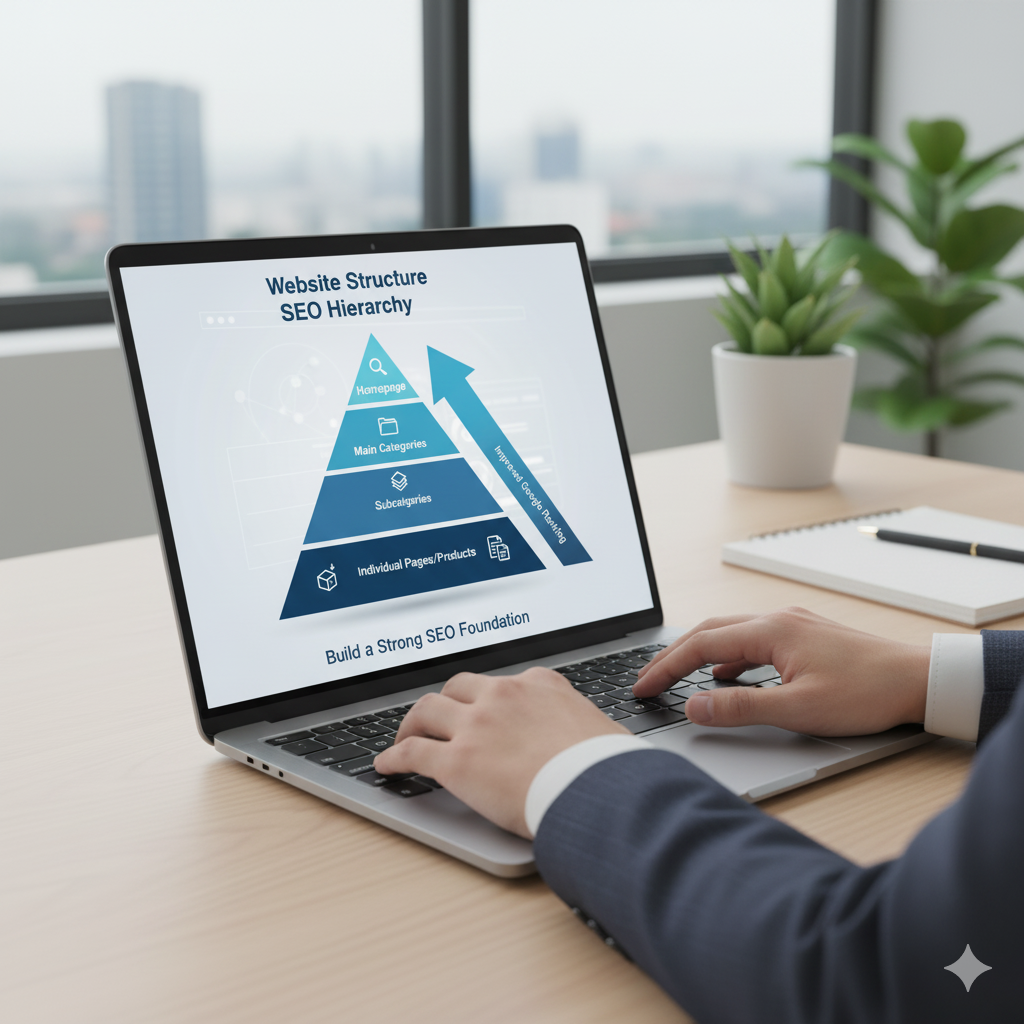
Logical Hierarchy: Your website should have clear levels of importance, with main topics at the top level and specific subtopics organized beneath them.
Intuitive Navigation: Visitors should easily understand how to move through your site and find information relevant to their needs.
Internal Linking: Strategic links between related pages help search engines understand content relationships while keeping visitors engaged.
URL Structure: Clean, descriptive URLs that reflect your site’s organization help both search engines and users understand page content and location.
Site Architecture: The overall framework connecting all pages should be logical, scalable, and aligned with your business goals.
The SEO Impact of Website Architecture
Website structure directly influences how search engines evaluate and rank your content. Understanding these connections helps business owners make informed decisions about site organization that support their SEO goals.
Crawl Efficiency and Index Coverage
Search engines allocate limited time and resources to crawling each website, known as “crawl budget.” Efficient website structure helps search engines discover and index more of your content within their allocated crawl time, increasing the chances that all your important pages appear in search results.
Factors Affecting Crawl Efficiency:
Site Depth: Pages buried several clicks deep from your homepage are less likely to be crawled frequently. Important content should be accessible within 3-4 clicks from your main navigation.
Internal Link Distribution: Pages with more internal links pointing to them are considered more important by search engines and receive more frequent crawling attention.
Technical Accessibility: Clean code, fast loading times, and mobile-friendly design help crawlers efficiently process your content.
Sitemap Organization: XML sitemaps that accurately reflect your site structure help search engines discover and prioritize your most important pages.
Content Authority and Topic Relevance
Well-structured websites demonstrate topical expertise and authority, important ranking factors in Google’s evaluation process. When related content is logically grouped and internally linked, search engines better understand your business expertise and are more likely to rank you for relevant searches.
Building Topical Authority Through Structure:
Content Clusters: Organize related content around main topics, with comprehensive cornerstone pages linking to specific subtopic pages.
Service Category Organization: Business services should be clearly categorized with logical subcategories that reflect how customers think about your offerings.
Geographic Organization: Local businesses benefit from location-specific pages organized by service areas, cities, or neighborhoods served.
Expertise Demonstration: Structure should highlight credentials, experience, case studies, and other authority signals throughout the site architecture.
Local SEO and Geographic Structure
Local businesses need website structure that clearly communicates geographic relevance and service areas to search engines. This geographic clarity directly impacts visibility for location-based searches that drive foot traffic and local customers.
Geographic Structure Elements:
Location Pages: Dedicated pages for each city, neighborhood, or service area with unique, relevant content for each location.
Service Area Hierarchy: Clear organization showing which services are available in which locations, helping search engines understand your geographic relevance.
Local Content Integration: Location-specific content, testimonials, and case studies distributed throughout the site structure to reinforce geographic authority.
Contact Information Architecture: Consistent NAP (Name, Address, Phone) information strategically placed throughout the site structure to support local search signals.
Practical Website Structure Strategies
Implementing effective website structure requires understanding both technical SEO principles and user experience best practices. These strategies help business owners create organized, search-friendly websites without requiring extensive technical expertise.
Planning Your Site Hierarchy
Before creating or restructuring your website, develop a clear plan for organizing content that serves both your business goals and customer needs. This planning phase prevents structural problems that are expensive to fix later.
Hierarchy Planning Steps:
Identify Main Categories: Determine 5-7 primary topics that encompass your business offerings, typically corresponding to your main services, products, or customer types.
Map Subcategories: Under each main category, identify 3-8 specific subtopics that provide detailed information about different aspects of your offerings.
Consider User Journey: Organize information to match how customers progress from awareness to consideration to decision-making about your services.
Plan Content Depth: Determine which topics need comprehensive coverage with multiple pages versus simpler, single-page treatments.
Account for Growth: Design structure that accommodates future expansion without requiring complete reorganization.
Navigation Design Best Practices
Your website’s main navigation serves as the primary roadmap for both visitors and search engines, making its design crucial for SEO performance and user experience.
Effective Navigation Principles:
Descriptive Labels: Use clear, specific language that immediately communicates what visitors will find on each page. Avoid generic terms like “Solutions” or “Services” when more specific descriptions would be clearer.
Logical Grouping: Related pages should be grouped together under appropriate main navigation categories, making it easy for visitors to explore all relevant information.
Consistent Structure: Navigation should remain consistent across all pages, helping visitors understand their location within your site and easily move between sections.
Mobile Optimization: Navigation must work flawlessly on mobile devices, where most local searches occur. This often requires simplified mobile navigation that maintains full functionality.
Search Engine Accessibility: Navigation elements should use standard HTML and CSS rather than JavaScript or other technologies that search engines might have difficulty processing.
Internal Linking Strategy
Internal links create pathways through your content while signaling to search engines which pages are most important and how different topics relate to each other.
Strategic Internal Linking:
Contextual Relevance: Links should naturally fit within content and genuinely help readers find related, valuable information.
Authority Distribution: Link to important pages from multiple other pages throughout your site to signal their importance to search engines.
Anchor Text Optimization: Use descriptive anchor text that clearly indicates what visitors will find on the linked page, incorporating relevant keywords naturally.
Deep Page Support: Ensure important pages that aren’t in main navigation still receive internal links from relevant content throughout your site.
User Experience Focus: Internal links should primarily serve visitor needs for additional information rather than purely SEO purposes.
URL Structure Optimization
Clean, logical URL structure helps both search engines and users understand your content organization while supporting your overall SEO strategy.
URL Best Practices:
Descriptive Paths: URLs should clearly indicate page content and location within your site hierarchy. For example: /services/plumbing/emergency-repair/ clearly shows the page’s topic and category.
Consistent Structure: URL patterns should remain consistent throughout your site, making it easy for users and search engines to understand your organization system.
Keyword Integration: Include relevant keywords in URLs naturally, without keyword stuffing or creating overly long paths.
Breadcrumb Support: URL structure should support breadcrumb navigation that helps users understand their location within your site.
Local Optimization: For local businesses, consider including geographic terms in URLs for location-specific pages and services.
Common Website Structure Mistakes That Hurt SEO
Understanding frequent structural problems helps business owners avoid costly mistakes that can significantly impact search engine rankings and user experience.
Overly Complex Navigation
Many websites suffer from navigation systems that try to include too many options or create overly complicated categorization schemes that confuse both visitors and search engines.
Navigation Complexity Problems:
Too Many Menu Items: Main navigation with more than 7-8 primary categories often overwhelms visitors and dilutes the importance of each section.
Unclear Categories: Vague or overlapping category names make it difficult for visitors to predict what they’ll find in each section.
Deep Nesting: Important content buried under multiple navigation levels may never be discovered by visitors or search engine crawlers.
Inconsistent Organization: Different sections of the site organized according to different logic systems create confusion and poor user experience.
Solutions:
- Limit main navigation to 5-7 clear, specific categories
- Use customer-focused language rather than internal business terminology
- Ensure important pages are accessible within 3 clicks of the homepage
- Test navigation with actual customers to identify confusion points
Duplicate Content and Thin Pages
Poor website structure often leads to duplicate content issues or pages with insufficient unique content, both of which can harm search engine rankings.
Content Structure Problems:
Service Duplication: Creating separate pages for slightly different service variations without sufficient unique content to justify separate pages.
Location Page Repetition: Multiple location pages with nearly identical content except for city names, providing little value to visitors or search engines.
Thin Content Pages: Pages with minimal content that don’t provide sufficient value to warrant their own dedicated page.
Template Overuse: Relying too heavily on template content that creates near-duplicate pages throughout the site.
Solutions:
- Combine similar services into comprehensive pages rather than creating multiple thin pages
- Develop substantial, unique content for each location page that provides genuine local value
- Ensure each page provides meaningful, unique value that justifies its existence
- Use templates as starting points but customize content significantly for each page
Poor Internal Link Distribution
Ineffective internal linking fails to help search engines understand page importance relationships while missing opportunities to keep visitors engaged with relevant content.
Internal Linking Problems:
Orphan Pages: Important pages that receive few or no internal links from other pages on the site may not be discovered by crawlers or visitors.
Link Hoarding: Concentrating most internal links on already well-linked pages while neglecting other valuable content.
Irrelevant Linking: Links that don’t genuinely help visitors or relate logically to the content context.
Missing Deep Links: Focusing internal links only on main pages while neglecting to support deeper, specific content pages.
Solutions:
- Audit your site to identify pages receiving few internal links and create relevant linking opportunities
- Include contextual links within content that genuinely help readers find related information
- Develop a linking strategy that distributes authority throughout your site
- Regularly review and update internal links as you add new content
Mobile Structure Problems
Many websites fail to consider how their structure translates to mobile devices, creating poor mobile experiences that hurt both user satisfaction and search rankings.
Mobile Structural Issues:
Complex Mobile Navigation: Desktop navigation systems that don’t adapt well to mobile screens, making it difficult for users to find information.
Touch Unfriendly Elements: Navigation and internal links that are difficult to use on touchscreen devices.
Mobile Page Speed: Structural elements that significantly slow mobile loading times, particularly problematic for local businesses where mobile usage dominates.
Mobile Content Organization: Information hierarchy that doesn’t work well on mobile screens, burying important content below the fold.
Solutions:
- Design mobile navigation separately from desktop to optimize for touch interaction
- Test website structure regularly on various mobile devices
- Prioritize mobile loading speed in structural decisions
- Consider mobile-first content organization that serves mobile users effectively
Advanced Structure Techniques for Better Rankings
Beyond basic organizational principles, several advanced techniques can significantly improve your website’s SEO performance and user experience.
Schema Markup and Structured Data
Schema markup helps search engines understand your website content and structure more precisely, often resulting in enhanced search result displays and improved rankings.
Structural Schema Applications:
Organization Schema: Markup that clearly identifies your business information, location, and contact details throughout your site structure.
Breadcrumb Schema: Structured data that helps search engines understand your site hierarchy and navigation paths.
Service Schema: Markup that clearly defines your service offerings and their relationships within your overall business structure.
Local Business Schema: For businesses with physical locations, schema that reinforces geographic relevance and local authority.
Implementation Considerations:
- Focus on schema types most relevant to your business and customer needs
- Ensure schema markup accurately reflects your actual content and structure
- Test schema implementation using Google’s validation tools
- Update schema markup when making structural changes to your website
Content Hub Development
Creating comprehensive content hubs around major topics demonstrates expertise while providing excellent user experience and strong SEO performance.
Content Hub Structure:
Pillar Pages: Comprehensive pages covering broad topics important to your business and customers, serving as the foundation for related content.
Cluster Content: Specific, detailed pages covering subtopics related to each pillar page, all linking back to and from the main hub.
Topic Authority: Hubs that demonstrate deep expertise in specific areas relevant to your business and customer needs.
User Journey Support: Hub structure that guides visitors from general interest to specific solutions you provide.
Hub Development Process:
- Identify 3-5 major topics central to your business and customer interests
- Create comprehensive pillar pages that serve as authoritative resources for each topic
- Develop supporting content that addresses specific aspects of each major topic
- Link strategically between related hub content to reinforce topic relationships
Technical Structure Optimization
Several technical elements significantly impact how search engines crawl and understand your website structure.
Technical Structure Elements:
XML Sitemaps: Comprehensive sitemaps that accurately reflect your site structure and update automatically as you add new content.
Robots.txt Optimization: Proper robots.txt configuration that guides search engine crawling while preventing access to irrelevant or duplicate content.
Canonical Tags: Proper use of canonical tags to prevent duplicate content issues and consolidate ranking signals.
Page Speed Optimization: Structural decisions that support fast loading times across all devices and connection types.
Security Implementation: HTTPS implementation and other security measures that search engines consider in ranking decisions.
Industry-Specific Structure Strategies
Different business types benefit from tailored structural approaches that address their specific customer needs and SEO opportunities.
Professional Services Structure
Law firms, accountants, consultants, and other professional service providers need website structure that builds credibility while clearly organizing service offerings.
Professional Services Structural Priorities:
Practice Area Organization: Clear categorization of different services and specializations with logical subcategories for specific expertise areas.
Credential Integration: Strategic placement of attorney profiles, certifications, and experience information throughout the site structure.
Case Study Architecture: Organized presentation of case studies and success stories that demonstrate expertise while supporting SEO for relevant practice areas.
Resource Hub Development: Comprehensive resource sections that establish thought leadership while attracting potential clients researching legal or professional service topics.
Local Court Integration: For legal practices, structure that addresses specific court jurisdictions and local legal considerations.
Retail and E-commerce Structure
Online retail businesses need structure that supports product discovery while optimizing for both search engines and conversion rates.
E-commerce Structural Elements:
Product Category Hierarchy: Logical product organization that matches customer shopping behavior and search patterns.
Faceted Navigation: Advanced filtering systems that help customers find products while maintaining SEO-friendly URL structure.
Product Information Architecture: Consistent product page structure that provides comprehensive information while supporting search optimization.
Shopping Cart Integration: Seamless integration between browsing structure and purchase processes that minimizes cart abandonment.
Review and Rating Integration: Customer review systems integrated throughout the product structure to support both conversion and SEO.
Restaurant and Food Service Structure
Restaurant websites need structure that entices visitors while providing practical information that drives reservations and visits.
Restaurant Website Structure:
Menu Organization: Clear menu categorization with detailed descriptions and pricing that supports both user experience and local search optimization.
Location Information Architecture: Prominent placement of location, hours, contact information, and reservation systems throughout the site structure.
Atmosphere Integration: Strategic use of photography and content throughout the structure to convey dining experience and ambiance.
Special Events Structure: Organized presentation of special events, private dining, catering, and seasonal offerings.
Review Integration: Customer testimonials and review displays integrated throughout the site structure to build trust and encourage visits.
Home and Professional Services Structure
Contractors, repair services, and home improvement companies need structure that builds trust while clearly communicating service capabilities and coverage areas.
Service Business Structure:
Service Category Organization: Clear categorization of different services with detailed descriptions of what’s included in each offering.
Geographic Coverage: Location-specific pages and service area information prominently featured throughout the site structure.
Project Gallery Integration: Before and after photos, project galleries, and case studies strategically integrated throughout the service structure.
Emergency Service Prominence: Clear structural emphasis on emergency availability, contact procedures, and response time commitments.
Licensing and Insurance Information: Professional credentials and insurance information easily accessible throughout the site structure.
Measuring Structure Effectiveness
Understanding how to evaluate your website structure’s performance helps identify improvement opportunities and demonstrate the value of structural optimizations.
SEO Performance Metrics
Several metrics directly reflect how well your website structure supports search engine optimization goals:
Crawling and Indexing Metrics:
- Number of pages indexed by search engines compared to total pages
- Crawl error rates and accessibility issues identified in Google Search Console
- Time required for new pages to appear in search results after publication
- Coverage reports showing which pages search engines can and cannot access
Ranking Performance:
- Keyword ranking improvements for target terms across different site sections
- Local search visibility for location-specific pages and services
- Organic traffic growth to different sections of your website
- Featured snippet and rich result appearances for structured content
Authority Signals:
- Internal link distribution and page authority metrics across your site
- External links attracted to different sections of your website
- Brand mention and citation patterns related to your site structure
- Social sharing patterns for different types of content and pages
User Experience Analytics
Website structure directly impacts user behavior, and these metrics help evaluate structural effectiveness:
Navigation Performance:
- Bounce rates for different sections and pages
- Average session duration and pages per session
- Navigation path analysis showing how visitors move through your site
- Exit page patterns that identify where visitors commonly leave your site
Conversion Tracking:
- Goal completion rates for different site sections
- Contact form submissions and phone calls generated from different pages
- E-commerce conversion rates and cart abandonment patterns
- Lead quality and customer lifetime value from different traffic sources
Mobile Experience Metrics:
- Mobile versus desktop user behavior patterns
- Mobile page loading times and performance scores
- Mobile navigation usage and success rates
- Mobile-specific conversion and engagement patterns
Business Impact Assessment
Ultimately, website structure should support your business goals and customer acquisition objectives:
Customer Acquisition:
- Lead generation improvements following structural optimizations
- Customer acquisition cost changes related to website performance
- Referral and word-of-mouth business generated through improved online experience
- Market share growth within your service area or industry
Operational Efficiency:
- Reduced customer service inquiries due to better information accessibility
- Improved qualification of leads through better content organization
- More efficient sales processes supported by better website structure
- Enhanced ability to expand services or coverage areas through scalable structure
Competitive Positioning:
- Search engine market share compared to direct competitors
- Online reputation and review patterns compared to industry benchmarks
- Website traffic growth relative to market and seasonal trends
- Customer preference and selection patterns in competitive scenarios
When to Seek Professional Help
While these strategies can be implemented independently, those with limited resources or expertise may benefit from professional assistance. At Popnest Media, our team of specialists can provide dedicated website structure optimization and technical SEO support tailored to your specific business needs. Visit our homepage to schedule a consultation with one of our experts.
Consider professional assistance when:
- Your current website structure confuses visitors and fails to support business goals effectively
- Technical implementation of structured data, sitemaps, or advanced SEO features seems overwhelming
- You need comprehensive site restructuring that maintains SEO value while improving user experience
- Your business operates in multiple locations or serves diverse market segments requiring complex structural solutions
- Competitors consistently outrank you despite your superior services, suggesting structural SEO disadvantages
- You want to implement advanced structure techniques like content hubs or schema markup without risking technical mistakes
- Your website structure needs integration with business systems like inventory management, booking, or customer relationship management
Professional website structure optimization ensures your site architecture supports both immediate business needs and long-term growth while maximizing search engine visibility and user satisfaction.
Future-Proofing Your Website Structure
Understanding emerging trends in search technology and user behavior helps business owners create website structures that remain effective as technology evolves.
Voice Search and Conversational Queries
Voice search growth requires website structure that supports natural language queries and conversational search patterns.
Voice Search Structural Considerations:
FAQ Integration: Comprehensive FAQ sections structured to address common conversational queries related to your business and services.
Natural Language Optimization: Content organization that addresses how people actually speak about your services rather than just how they type search queries.
Local Query Support: Structure that effectively answers location-based voice queries like “find a plumber near me” or “best restaurants in [neighborhood].”
Quick Answer Formatting: Content structured to provide concise, direct answers that voice assistants can easily extract and present.
Mobile-First Indexing Evolution
Google’s mobile-first indexing means your website structure must prioritize mobile user experience while maintaining desktop functionality.
Mobile-First Structural Priorities:
Mobile Navigation Design: Structure that works efficiently on mobile devices without sacrificing functionality or user experience.
Content Prioritization: Mobile structure that presents the most important information prominently without requiring extensive scrolling.
Loading Speed Optimization: Structural decisions that support fast mobile loading times across different connection speeds.
Touch Interaction Design: Structure elements optimized for touch interaction rather than just mouse and keyboard use.
Artificial Intelligence and User Personalization
AI-powered search and personalization technologies require website structure that supports dynamic content delivery and user customization.
AI-Ready Structural Elements:
Content Flexibility: Structure that accommodates personalized content delivery based on user behavior, location, and preferences.
Data Integration: Architecture that supports integration with AI tools for customer service, personalization, and automated content generation.
User Journey Optimization: Structure that adapts to different user types and behavior patterns identified through AI analysis.
Performance Scalability: Architecture that maintains performance as AI features and personalization increase site complexity.
Conclusion: Building Structure That Drives Results
Website structure SEO success requires balancing technical optimization with genuine user value, creating architecture that serves both search engines and your customers effectively. The most successful business websites organize information logically, guide visitors naturally toward conversion actions, and provide search engines with clear signals about content relevance and authority.
Remember that website structure optimization is an ongoing process rather than a one-time project. As your business grows, your market evolves, and technology advances, your website structure should adapt to maintain effectiveness. Regular evaluation and refinement ensure your structure continues supporting your business goals while meeting changing customer expectations.
Start by evaluating your current website structure against the principles outlined in this guide. Focus on fundamental improvements like clear navigation, logical content organization, and effective internal linking before attempting advanced techniques. Many businesses see significant SEO improvements from addressing basic structural issues that have been hindering their search performance.
Your website structure directly impacts whether potential customers find your business online, understand your offerings, and choose to contact you over competitors. Poor structure can hide excellent content and services, while good structure amplifies your business strengths and competitive advantages.
Ready to transform your website structure into a powerful SEO asset that drives real business results? Don’t let poor organization continue limiting your online visibility and customer acquisition potential. Your competitors aren’t waiting to improve their website structure, and neither should you.
The team at Popnest Media specializes in creating website architectures that excel at both search engine optimization and user experience. We understand how to balance technical SEO requirements with practical business needs, ensuring your structure supports immediate goals while positioning you for long-term success. From simple navigation improvements to comprehensive site restructuring, we’ll help you build the foundation for sustainable online growth. Contact us today to discover how professional website structure optimization can unlock your site’s full potential and drive more qualified traffic to your business. Schedule your consultation and take the first step toward website structure that actually works for your success.
Frequently Asked Questions
How long does it take to see SEO improvements from website structure changes?
Website structure improvements typically show initial results within 4-8 weeks, with more significant ranking improvements developing over 3-6 months. The timeline depends on how extensive your changes are and how frequently search engines crawl your site. Simple navigation improvements may show faster results, while comprehensive restructuring requires more time for search engines to fully process and evaluate changes.
Will restructuring my website hurt my current search rankings?
Properly executed website restructuring usually improves rankings over time, but temporary fluctuations are normal during the transition period. The key is implementing proper redirects, maintaining URL structure where possible, and ensuring search engines can still access all important content. Professional implementation minimizes risks while maximizing long-term benefits.
How many main navigation categories should my business website have?
Most effective business websites use 5-7 main navigation categories. This provides sufficient organization for comprehensive service offerings while avoiding overwhelming visitors with too many choices. Each main category can include 3-8 subcategories for more detailed organization. The exact number depends on your business complexity and customer needs.
What’s the difference between website structure and site architecture?
Website structure refers to how individual pages are organized and connected, while site architecture encompasses the broader technical framework including hosting, databases, and content management systems. For most business owners, focusing on content organization, navigation design, and internal linking (website structure) provides the most immediate SEO and user experience benefits.
Can I improve my website structure without hiring a developer?
Many website structure improvements can be implemented using content management systems like WordPress without custom development. Changes like navigation reorganization, internal linking improvements, and content restructuring often require no technical coding. However, advanced optimizations like schema markup, technical redirects, or complex structural changes may benefit from professional assistance.